
If you searched for a B2B advertising agency, there’s a good chance you actually mean something more specific: an agency that can run LinkedIn, Google, and Meta campaigns for a B2B audience and make the spend produce pipeline, not an agency that does branding, PR, or general positioning work under the same “advertising” label. This page is about the first kind.
Every agency below lives and dies by paid media execution. We left out generalist B2B marketing shops, brand agencies, and PR firms that use “advertising” loosely to describe a small slice of what they do. That’s a deliberate scope decision, and it’s also the first item in the methodology below: specialization fit isn’t a nice-to-have when you’re handing someone a live ad account and a monthly budget.
Here’s what’s in this post:
- The 12-point methodology we use to evaluate paid-media agencies, plus a red-flags checklist for proposals
- Eight paid-media specialists (plus New North) with real B2B experience, and what each one is actually good at
- A quick way to match your situation to the right kind of partner
Paid media is also where New North’s own Reach program lives, the part of our work built specifically for getting in front of the right buyers when you don’t know their names yet, paired with the conversion and nurture content that turns clicks into pipeline. So we have a direct stake in how this category gets evaluated, which is exactly why the criteria come before the list.
How to evaluate a B2B paid advertising agency
Most “top agency” lists rank by criteria the writer never states. That’s how a mediocre agency ends up next to a good one: nothing was actually being measured. This gets worse in paid media specifically, where a slick dashboard and a big “managed ad spend” number can hide a proposal built entirely on outcomes nobody can verify.
Here’s the methodology we built this list against. Use it on these nine agencies, and use it on any agency pitching you next, including us.
- Team model transparency. Can you name who’s actually doing the work, strategist, writer, designer, developer, analyst, or is it an opaque “account manager plus subcontractors” you’ll never meet? This is checkable on a sales call. Ask for names and roles before you sign anything.
- Accountability structure. What is the agency actually on the hook for? There’s a ladder here: delivery only (what shipped), leading indicators (traffic, conversion rate, cost per lead), or the full plan and its measurement. Most agencies stay vague about which rung they’re on. Ask directly.
- The lead or pipeline guarantee question. Treat this as a red-flag detector, not reassurance. Any agency promising a specific number of leads or pipeline dollars before doing diagnostic work on your business is either overpromising or guessing. The credible answer is a forecast built from your own historical and competitive data, reported against every month, not a number pulled from a sales deck. This one matters more on this page than most: lead and pipeline guarantees show up constantly in paid-media sales pitches, precisely because the channel feels measurable enough to make the promise sound credible.
- Specialization fit, not just size fit. “We’ve worked with some tech clients” is a different claim from “most of our book is B2B tech.” Ask what percentage of their current clients are B2B tech companies with your kind of buying cycle and technical buyer.
- Strategy-execution model. Some agencies are strategic consultancies that hand you a deck and leave. Some are execution vendors waiting on a strategy you don’t have. Fewer do genuinely both under one roof. Know which one you’re hiring before you sign.
- Pricing model transparency. Can the agency explain, in one or two plain sentences, how a scope change moves the price? If the answer is “it depends” with no follow-up, that’s a signal, not an answer.
- Visibility into work in progress. Is there a real-time portal or dashboard you can check any day, or do you find out what happened in a monthly status deck two weeks after the fact?
- Proof of work, adjusted for reality. Plenty of good agencies, New North included, can’t publish named case studies because of client confidentiality. That’s normal, not disqualifying. What matters is whether they can show you real work samples, campaigns, ad creative, landing pages, even without attributable results attached. Zero visible proof of anything is the actual problem. And when a case study does list a number, check what’s actually being measured: a “44% increase in SQLs” and a “2.76x ROAS” answer different questions, and a good agency will tell you which one it’s claiming.
- Ramp and contract flexibility. What’s the minimum commitment? What does month one actually look like: onboarding and research, or campaigns already live? A defined ramp is a good sign; a vague “we’ll figure it out” is not.
- Who actually touches the account. Is a senior strategist involved throughout, or does the account get handed to junior staff the week after the contract is signed?
- Tech stack transparency and cost bundling. What stack does the agency actually run on, their own tools, your existing stack, or a mix, and is that cost bundled into the retainer or billed separately and disclosed upfront? Ask for the specific tools before you sign, not after a separate tech bill shows up.
- Baseline and benchmarking methodology. How does the agency establish a starting baseline before a program launches? Do they audit your past paid-media efforts, even informal ones, to set a realistic benchmark, or do they start from an arbitrary or generic number? An agency with no stated baseline methodology can’t credibly show improvement later, because there’s nothing real to measure against.
Red flags in a proposal, worth naming explicitly:
- Deliverables described only in outcomes (“more leads,” “brand awareness”) with no itemized scope behind them
- A specific lead or pipeline number promised before any diagnostic work has happened
- No named individuals on the account, just a generic “team”
- Case studies with no stated measurement methodology, how the result was tracked, over what period, attributed how
- A proposal that reads like it could go to any company in any industry
- No visibility mechanism offered until you ask for one
We built this list of nine agencies against these twelve evaluation criteria, layered on top of the baseline you’d expect from any credible option: real B2B experience, hands-on channel expertise across LinkedIn, Google, and Meta, and some evidence of results tied to a stated method.
If paid media is only part of what you need, the same method applied to the wider category is in our comparison of B2B marketing agencies, technology marketing agencies and account-based marketing agencies. For the mechanics of the channels themselves rather than who runs them, see our B2B paid advertising playbook, what a demand generation agency actually does, and everything filed under demand generation and paid media.
Here are nine B2B paid advertising agencies worth evaluating:
- New North
- Omni Lab
- Impactable
- Obility
- Hey Digital
- Aimers
- 42 Agency
- KlientBoost
- Konstruct Digital
Note: We’ve listed these in the order that makes sense for this post, not a ranking. Each agency has different strengths that might make them the right fit for your specific situation.
1. New North
At a Glance
- Founded: 2008
- CEO: Justin Brown
- Notable clients: Aquatic Informatics, Ricoh Global Software, DocLib, Tyfone, FoxyAI
- Clutch Score: 4.6 stars
We’re listing ourselves first because this is our blog.
Paid media sits inside our Reach program, the piece of our work built for getting in front of the right buyers before they know your name, paired with the conversion and nurture content that turns a click into a real conversation. It’s run by named specialists, a paid media lead, a strategist, an analyst, working under one account director you actually know, not a rotating cast that changes every quarter.
We don’t guarantee leads, pipeline, or closed revenue from paid campaigns, and neither can anyone else running this kind of program. What we do instead: build a specific forecast from your own historical and competitive data, then report against that forecast every month, through a client portal where every task is logged and tied to the plan. That forecast is also our baseline, it’s built from your own numbers, not an arbitrary target, so there’s something real to measure improvement against.
Our engagement structure is built around three named tiers, Execute, Perform, and Grow, and three programs, Authority, Reach, and Pursuit. Reach is available starting at Execute, so paid media doesn’t require the largest engagement to access, though the level of shared strategy ownership changes as you move up.
Bottom Line
New North works best for B2B tech companies that want a named team running paid media with real visibility into the work and a forecast instead of a guaranteed lead number.
2. Omni Lab
At a Glance
- Founded: 2020, by Jason Steele and Jonathan Bland
- Headquarters: Austin, TX
- Notable clients: ShareGate, Billd, Miter, Thoropass, Drata, Firstup, Broadsign, Anvilogic
- Focus: B2B SaaS paid media and demand gen only
Omni Lab is an exclusively B2B SaaS paid-media and demand-generation agency running LinkedIn, Google, Meta, YouTube, Bing, and Reddit campaigns. It targets Series A through C companies already spending $10,000 or more a month on paid media, so this is built for a company past the earliest testing stage, not one running a first campaign.
The agency runs a proprietary reporting platform it calls “Omni OS,” connected directly to the client’s CRM rather than a generic ad-platform dashboard, which is a clearer answer to the visibility question than most agencies give. Its named case studies are specific about what’s being measured: ShareGate saw 44% year-over-year SQL growth and a 2.76x ROAS, Billd cut cost per SQL by 75%, Miter roughly doubled monthly SALs in 90 days, and Thoropass doubled paid SQLs in a quarter.
Bottom Line
Omni Lab works best for venture-backed B2B SaaS companies already spending meaningfully on paid media that want a specialist with quantified, CRM-connected reporting rather than a generalist agency.
3. Impactable
At a Glance
- Notable positioning: “First Independent LinkedIn Marketing Partner”
- Clutch Score: 3.8
- Managed spend: $21M+ in B2B ad spend, 114+ campaigns run
Impactable is a LinkedIn Ads specialist, with Google and paid search work as a secondary channel. Its LinkedIn-only positioning is a narrower specialization claim than most agencies on this list, worth weighing against your own channel mix: if LinkedIn carries most of your paid budget, that focus is an advantage; if you need Google or Meta running at the same level, ask directly how deep that expertise goes.
Its named case studies include Lacework (a 6X ROI result published as a LinkedIn case study) and HeyReach (20X ROI). The Clutch rating of 3.8 is lower than most other agencies on this list, worth asking about directly rather than assuming it reflects overall service quality.
Bottom Line
Impactable works best for B2B companies whose paid strategy is built primarily around LinkedIn and want a specialist rather than a generalist running that channel.
4. Obility
At a Glance
- Notable clients: Snowflake, Fastly, Hitachi Vantara, Autodesk
- Clutch Score: 4.8 (27 reviews)
- Services: Paid search, paid social, SEO
Obility is an established B2B paid search, paid social, and SEO agency with a strong Clutch record and enterprise-caliber named clients. Worth being direct about a real difference from New North: Obility explicitly positions itself for “hyper-growth B2B tech companies,” a client-fit philosophy built around scaling fast, not New North’s mid-market, not-growth-at-all-costs positioning. Neither approach is wrong; they’re built for different companies at different stages, and it’s worth knowing which one you are before you sign.
Beyond the positioning difference, Obility’s SEO offering alongside paid media means a client can consolidate both channels under one team, which simplifies attribution across search-driven and paid-driven traffic if that consolidation matters to you.
Bottom Line
Obility works well for hyper-growth B2B tech companies that want an established paid-search-and-social specialist built for scaling fast, a different client-fit philosophy than a mid-market-focused agency.
5. Hey Digital
At a Glance
- Notable clients: PostHog, Toggl
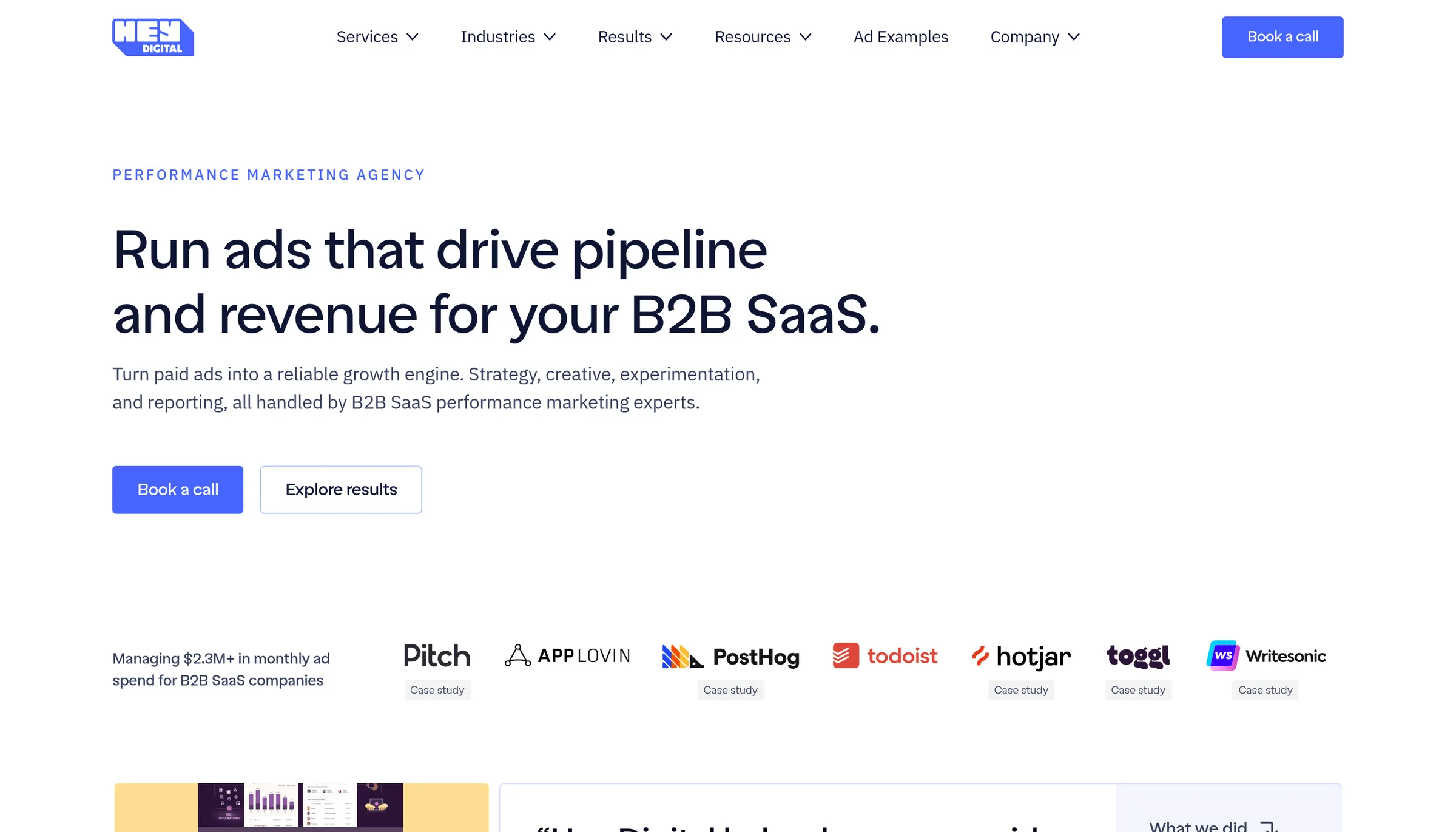
- Managed spend: $2.3M+/mo, 200+ B2B SaaS clients
- Channels: LinkedIn, Google, Meta, YouTube, Bing, Reddit
Hey Digital is an exclusively B2B SaaS performance-marketing and paid-media agency, managing over $2.3M a month in ad spend across more than 200 SaaS clients. That volume of concurrent clients is worth a direct question about how account attention gets split, tied to criterion 10 above: who’s actually running your account day to day.
Its named case studies are specific: PostHog saw an 18.5% increase in cloud conversions and a 17% decrease in cost per acquisition, and Toggl cut ad spend by 52% while increasing deal value by 159%. Both results are framed around a defined metric rather than a vague “improved performance” claim.
Bottom Line
Hey Digital works well for B2B SaaS companies that want a high-volume paid-media specialist with a track record of named, metric-specific case studies.
6. Aimers
At a Glance
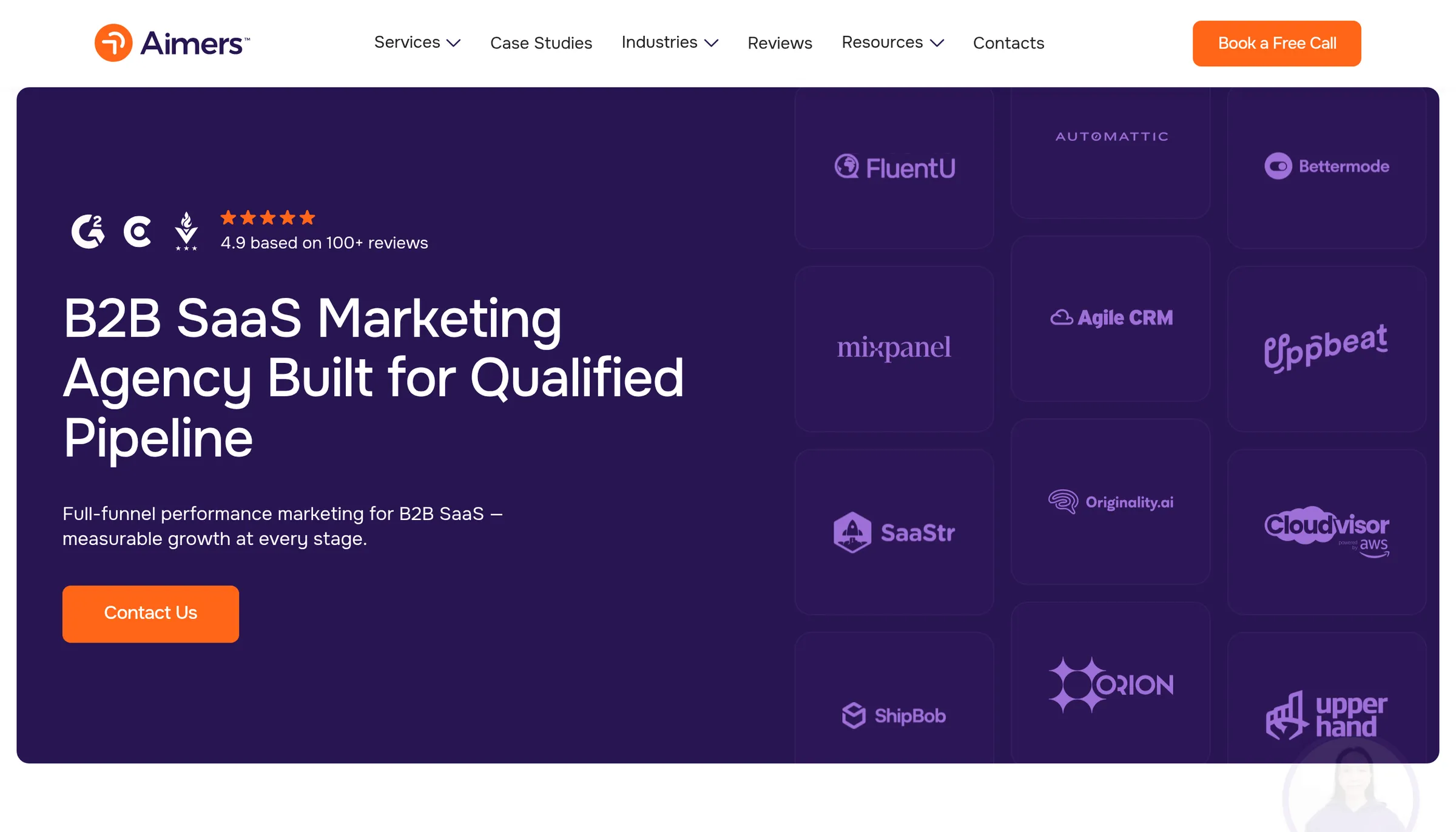
- Notable clients: Mixpanel, ShipBob, Automattic/Jetpack, Originality AI, Orion, Demio
- Managed spend: $30M+, 100+ clients
- Status: Google Premier Partner
Aimers is explicitly a B2B SaaS paid-media performance specialist, running PPC, paid social, CRO, and landing page work, with $30M+ in managed ad spend across 100+ clients and Google Premier Partner status. It carries Clutch and G2 badges on its own site, though we haven’t independently verified the specific ratings behind them, so ask to see the current scores directly rather than taking the badge at face value.
Its named clients span a real range of B2B SaaS, from Mixpanel and Automattic/Jetpack to smaller names like Originality AI and Demio, which is a reasonable signal that the agency works across company sizes rather than only the largest logos.
Bottom Line
Aimers works well for B2B SaaS companies that want a paid-media specialist with CRO and landing-page work bundled in rather than paid media alone.
7. 42 Agency
At a Glance
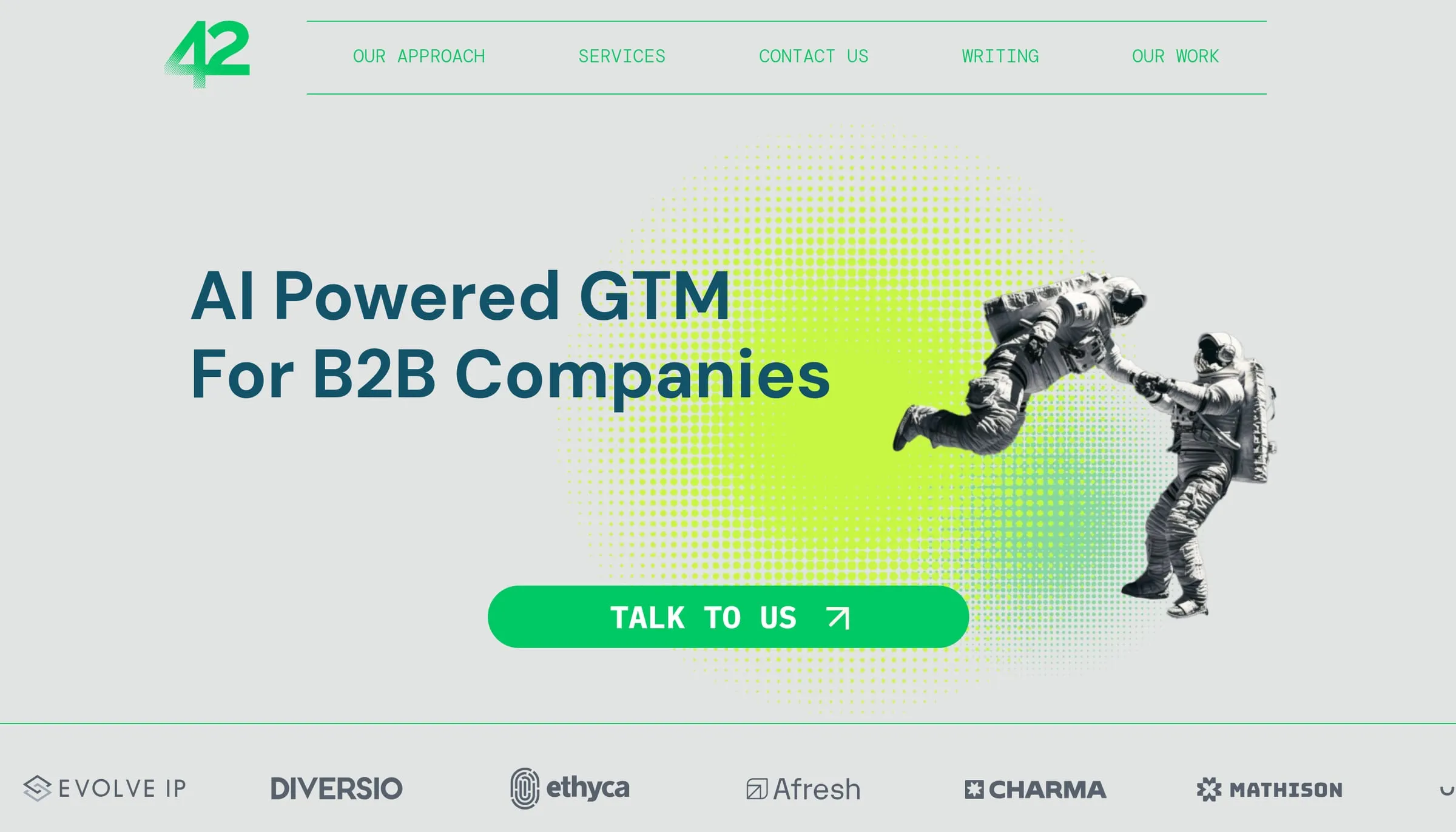
- Notable clients: Profitwell, Cin7, Smile, Charma
- Positioning: “AI-powered GTM” agency
42 Agency serves B2B SaaS companies, but worth being direct about scope: it positions itself as a broader “AI-powered GTM” agency spanning demand gen, marketing ops, SEO and content, and creative, where paid media is one service line among several rather than the agency’s sole identity. That’s a similar distinction to how a couple of the broader agencies on our B2B marketing agency comparison get framed: useful if you want one team running everything, less useful if you specifically want a paid-media specialist and nothing else.
Its named case studies, Profitwell, Cin7, Smile, and Charma, are real B2B SaaS clients, but the results tie to the broader GTM engagement rather than paid media in isolation, so it’s harder to isolate what paid spend specifically produced.
Bottom Line
42 Agency works well for B2B SaaS companies that want paid media bundled into a broader GTM engagement with marketing ops, SEO, and creative, rather than a dedicated paid-media specialist.
8. KlientBoost
At a Glance
- Headquarters: Costa Mesa, CA, with offices in Raleigh, NC and London
- Clutch Score: 4.9 (404 reviews)
- Notable clients: SAP, Segment, Hotjar, Upwork, Justworks
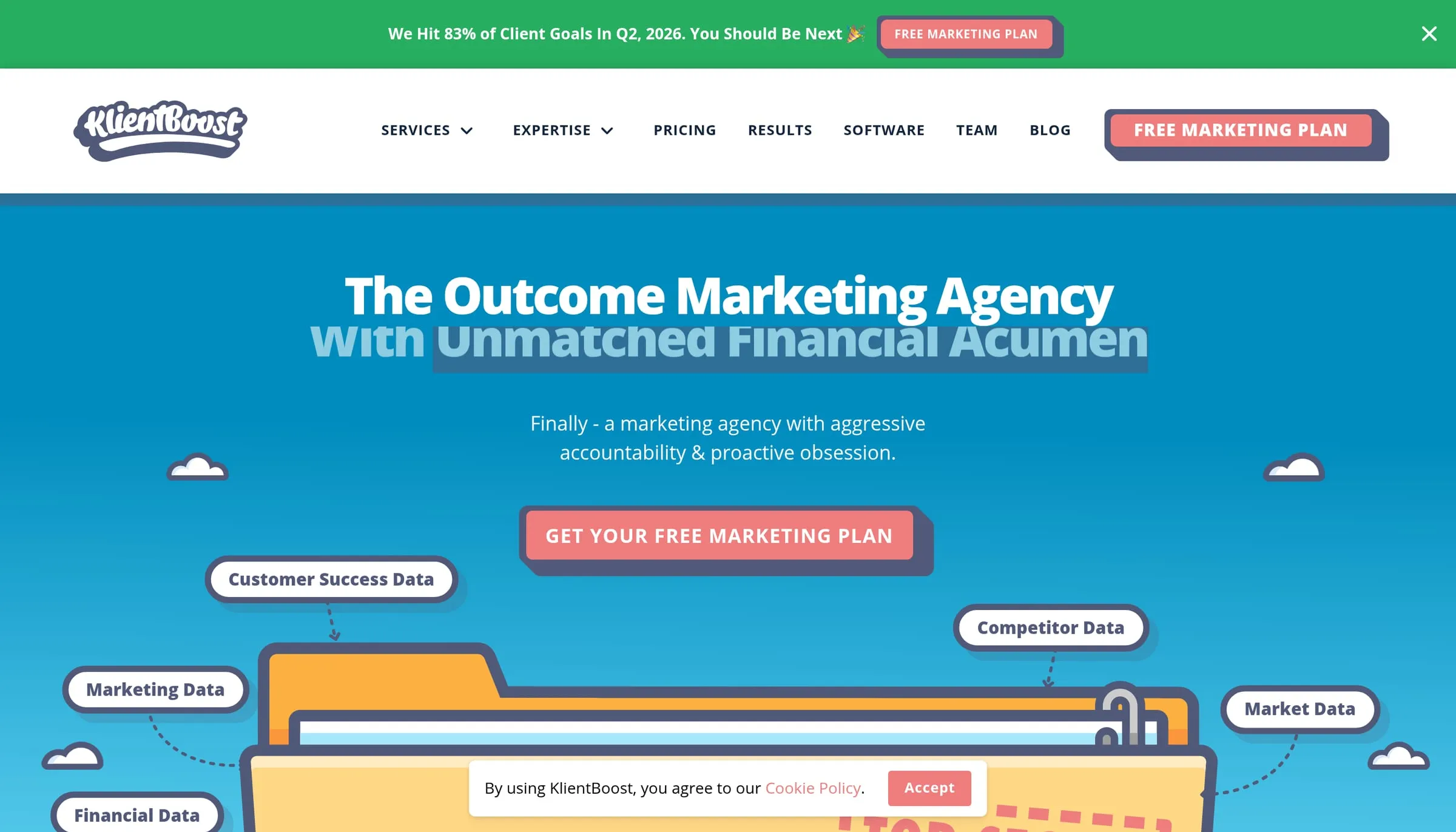
KlientBoost is an established, well-reviewed paid-media agency running the full suite: PPC, Google Ads, LinkedIn Ads, Facebook Ads, and SEM, with SEO, CRO, and email as secondary services. Its 4.9 rating across 404 Clutch reviews is the highest volume of reviews on this list by a wide margin.
Worth being direct about one real difference: KlientBoost’s client base is broader than a pure B2B specialist. Its named clients mix legitimate B2B names, SAP, Segment, Hotjar, Upwork, Justworks, alongside a more B2C-flavored roster elsewhere on its site. That’s not a knock on the work; it just means less of the agency’s day-to-day is built exclusively around B2B buying cycles than the SaaS-only specialists on this list. KlientBoost also runs proprietary tools worth asking about directly: “Kite” software and a “Growth Grid” ROI-forecasting model.
Bottom Line
KlientBoost works well for companies that want a large, heavily reviewed paid-media generalist with proprietary reporting tools, rather than an agency whose entire book is B2B-only.
9. Konstruct Digital
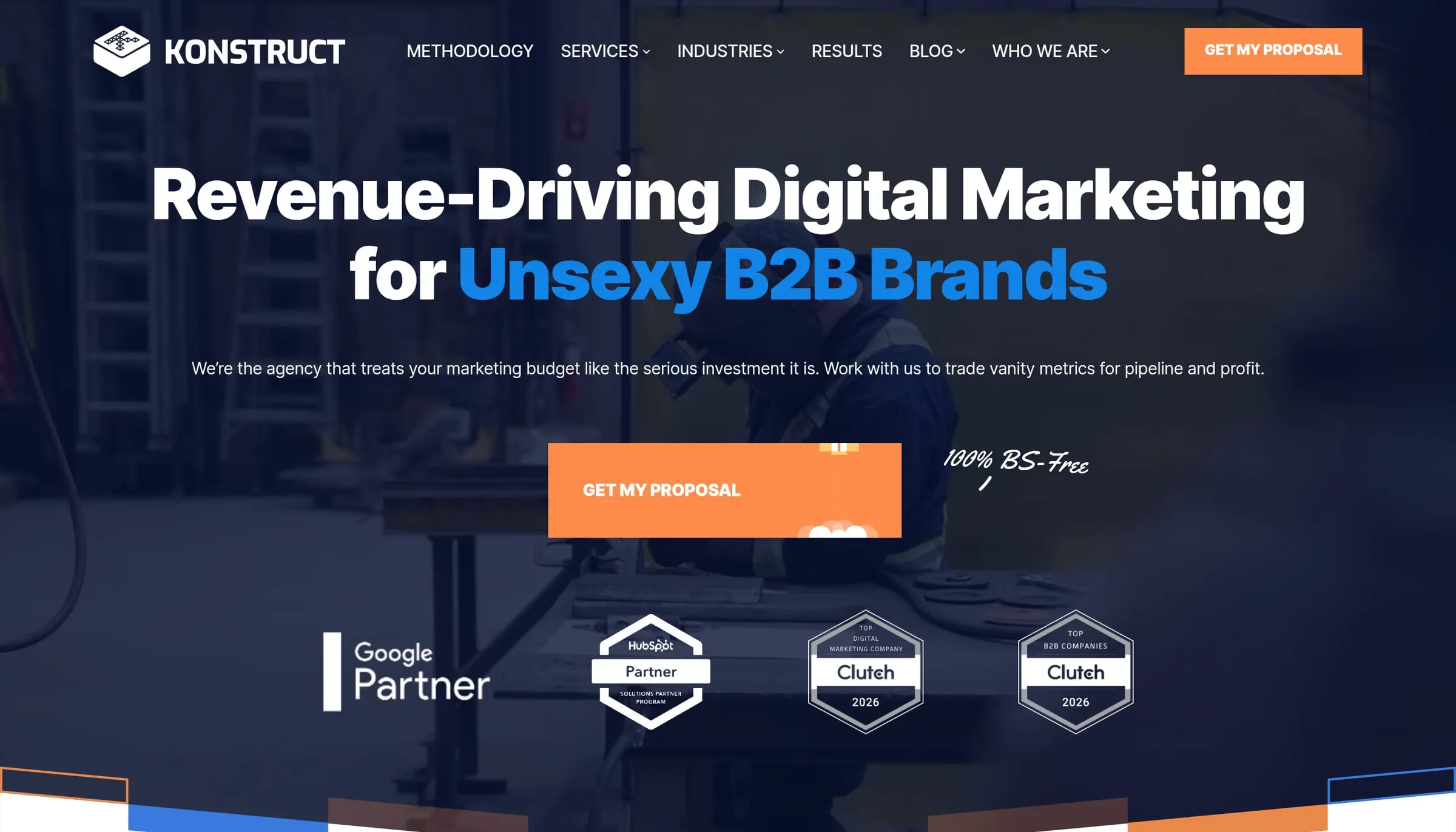
At a Glance
- Headquarters: Canada, 13 years in operation
- Recognition: Clutch “Top B2B Companies Canada 2026” badge, 60+ Clutch reviews
- Notable clients: Regal Rexnord, Gates, Crane, Wabash, Proterial
Konstruct Digital runs a named “Go-To-Revenue (GTR)” methodology and carries a strong Clutch record after 13 years in the space. Worth being direct about fit: its named clients, Regal Rexnord, Gates, Crane, Wabash, Proterial, put its real strength in industrial, manufacturing, and logistics B2B, not the tech-specialist lane most other agencies on this list occupy. It does list “Industrial Technology” and “Industrial Software” as a served niche, so there’s some overlap, but its core book skews to a different vertical than New North’s core B2B tech ICP.
Bottom Line
Konstruct Digital works well for industrial, manufacturing, or logistics B2B companies that want a named GTR methodology and a strong regional track record, a different vertical fit than most others on this list.
Ready to choose your paid media partner?
You now have nine agencies to evaluate, and a methodology to evaluate them with. In a category this crowded, the difference between an agency that moves pipeline and one that burns budget usually isn’t the platform certifications on the homepage, it’s the twelve things above: who’s actually running the account, what they’re accountable for, whether they promised you a lead number before doing any diagnostic work, and whether they can show you a real baseline instead of a made-up one.
Match your situation to the right kind of partner:
- B2B tech company wanting paid media with real visibility and a forecast, not a guarantee? New North’s Reach program gives you named specialists and a live view of the work.
- Venture-backed B2B SaaS company already spending $10K+/mo? Omni Lab’s CRM-connected reporting and quantified case studies fit.
- Paid strategy built mainly around LinkedIn? Impactable’s LinkedIn-first specialization fits.
- Hyper-growth B2B tech company? Obility’s paid-search-and-social track record fits that specific growth stage.
- High-volume B2B SaaS paid media with metric-specific case studies? Hey Digital fits.
- B2B SaaS wanting paid media bundled with CRO and landing pages? Aimers fits.
- Want paid media as part of a broader AI-powered GTM engagement? 42 Agency fits.
- Want a large, heavily reviewed generalist paid-media shop? KlientBoost fits, with the caveat that its book isn’t B2B-only.
- Industrial, manufacturing, or logistics B2B company? Konstruct Digital’s GTR methodology and vertical depth fit.
Apply the twelve-point checklist above to whichever agency you’re closest to signing with, including us. We don’t guarantee a lead number before doing the diagnostic work, we build a forecast from your data and report against it monthly.
If you want a second opinion before you commit to any of these nine, the next step is a conversation, not a contract: get a free shortlist assessment and we’ll help you weigh your options against the criteria above.
FAQ
Should I hire a paid-media specialist or a full-service agency for my B2B paid ads?
How should I evaluate an agency's "managed ad spend" or ROI case study claims?
Should I trust an agency that guarantees a specific number of leads or pipeline from paid ads?
What channels do B2B paid advertising agencies typically run?
How long does it take to see results from a B2B paid media agency?
What should we have in place before talking to a paid-media agency?
How is hiring a paid-media agency different from hiring an in-house paid media manager?


